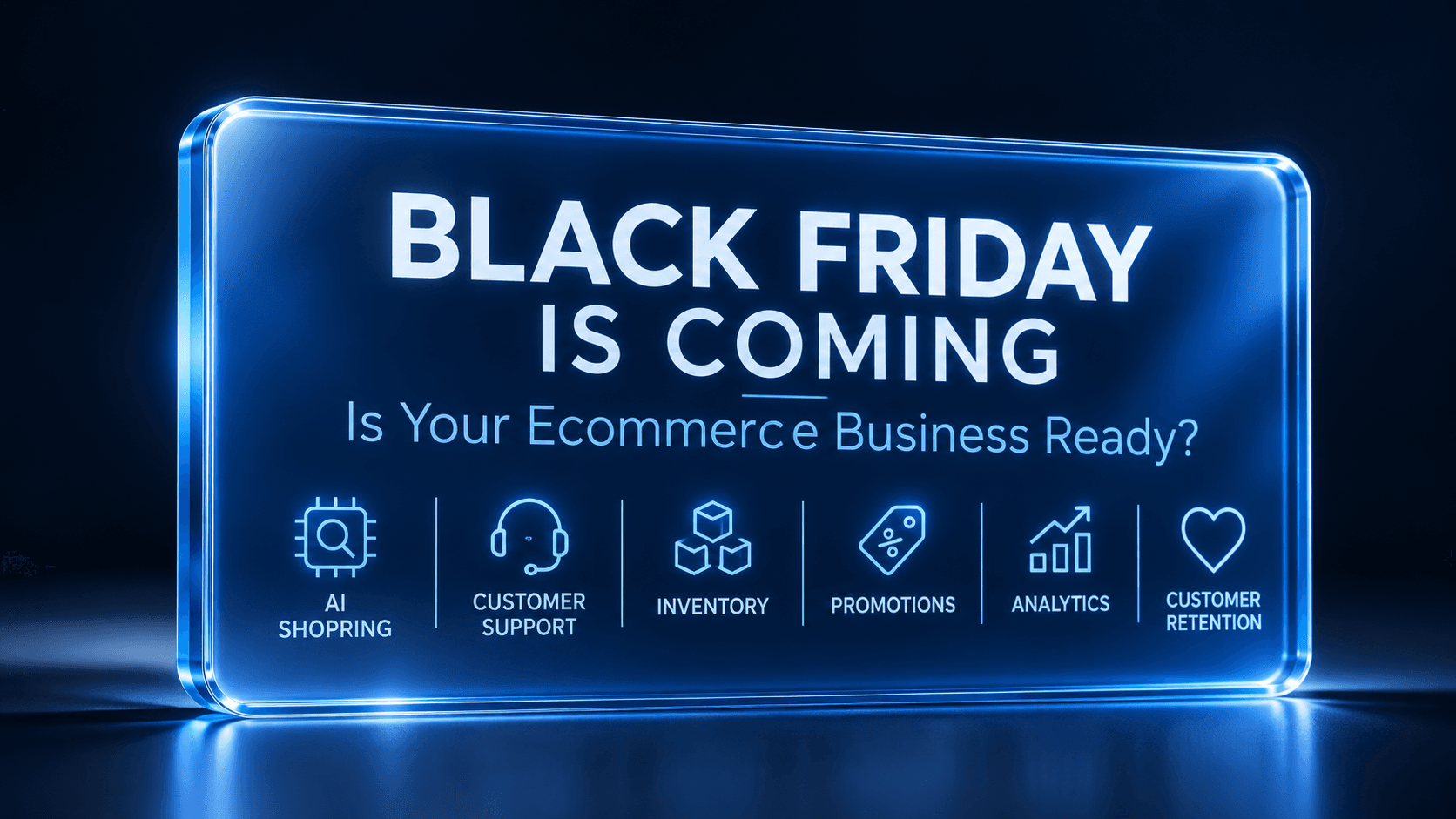
The Shopping Season Is Coming: Is Your Ecommerce Business Ready?

The biggest shopping season of the year is approaching. Black Friday and Cyber Monday bring ecommerce businesses an opportunity to attract new customers, increase sales and introduce their products to a much wider audience.
But here's something worth thinking about.
What happens when hundreds of customers visit your website simultaneously? Can they find the products they actually need? Can your checkout handle multiple purchases of limited-stock products? Are your promotional rules configured correctly? And can your customer support team manage the sudden increase in enquiries?
Getting more visitors to your ecommerce store is only one part of seasonal preparation.
The real challenge is ensuring that every part of your ecommerce operation can handle the increased demand without creating unnecessary problems or losing valuable sales opportunities.
Before launching your next seasonal campaign, here are six important areas worth reviewing, along with examples of how well-known businesses are approaching similar challenges.
1. Go Beyond Traditional Product Search with AI Shopping Assistants
Imagine a customer visiting your ecommerce store during Black Friday.
They're looking for a laptop under $1,000 with at least 16GB of RAM, suitable for graphic design.
Your store has hundreds of laptops available.
The customer starts applying filters, opening product pages and comparing specifications. After browsing several products, they're still unsure which one is right for them.
Now imagine if they could simply ask:
"I need a laptop for graphic design under $1,000 with at least 16GB RAM. Which one would you recommend?"
An AI-powered shopping assistant can understand this request, search your product catalogue, compare relevant specifications and recommend products that match the customer's requirements.
Instead of manually navigating through hundreds of products, customers can describe what they need and receive more relevant recommendations.
See How Amazon Is Transforming Product Discovery with Rufus
https://www.aboutamazon.com/news/retail/amazon-rufus
Amazon introduced Rufus, its generative AI shopping assistant, to help customers discover products through conversational interactions.
Customers can ask questions about products, compare different options, explore recommendations and get shopping assistance without relying entirely on traditional keyword searches.
For example, someone looking for a suitable laptop can ask questions about its intended use, specifications and differences between models.
This is an interesting development because it changes how customers interact with an ecommerce catalogue. Instead of simply searching for a product, they can have a conversation that helps them make a purchasing decision.
What could your ecommerce store implement?
An AI shopping assistant can offer several capabilities:
- Natural-language product searches: Understand requests such as "a lightweight backpack for weekend travel."
- Product comparisons: Compare specifications, features and prices based on customer requirements.
- Intelligent product combinations: Recommend compatible accessories and complementary products.
- Product-specific answers: Retrieve information about warranties, specifications and compatibility from your actual catalogue.
- Personalised recommendations: Refine suggestions based on customer preferences and stated budgets.
The important part is integrating AI with accurate product catalogue information, compatibility data and current pricing and inventory records.
The assistant should recommend products using verified information rather than generating unsupported answers.
What to review: Can your ecommerce store help customers discover, compare and select products through natural-language searches and intelligent recommendations?
2. Prepare Your Customer Support for Hundreds of Seasonal Enquiries with AI
More orders usually mean more customer enquiries.
During Black Friday and Cyber Monday, customers might contact your business to ask:
- Has my order been confirmed?
- When will my product arrive?
- Is this product still available?
- Can I change my delivery address?
- How can I return an item?
- Why isn't my promotional code working?
Individually, these questions are relatively straightforward. However, handling hundreds of similar enquiries manually can quickly overwhelm your customer support team.
This is where AI-powered customer support and automated issue resolution can make a difference.
Unlike traditional chatbots that depend on predefined questions and answers, integrated AI support assistants can understand customer requests and retrieve relevant information from your ecommerce systems.
Discover How Walmart Is Using AI to Improve Shopping Experiences
!image.png
https://corporate.walmart.com/news/2025/06/06/walmart-the-future-of-shopping-is-agentic-meet-sparky
Walmart has been investing in generative AI to improve both customer shopping experiences and customer support.
Its AI-powered customer service experiences are designed to help customers with enquiries such as finding orders, managing returns and obtaining assistance.
Walmart has also introduced Sparky, an AI-powered shopping assistant that helps customers discover products and make shopping decisions.
The interesting takeaway is that AI can support customers at multiple stages of their shopping journey, rather than being limited to answering basic FAQs.
What could your ecommerce store implement?
Imagine a customer asking:
"I placed an order yesterday. Has it been shipped yet?"
The AI assistant can connect to your order management system, retrieve the relevant order information and provide the latest available status and tracking details.
Similarly, it can:
- Automatically answer order-status questions.
- Provide product availability information.
- Explain delivery and return policies.
- Guide customers through approved return procedures.
- Categorise incoming support enquiries.
- Escalate complicated issues to human agents.
Not every issue should be handled automatically.
Consider a customer who has been charged twice or whose payment was successful but whose order wasn't created.
These situations require additional investigation.
Your AI support system should recognise when an issue requires human intervention and transfer the conversation to an appropriate support agent.
Ideally, the agent should receive a summary of the customer's problem and the information already retrieved, so the customer doesn't have to explain everything again.
What to review: Can your customer support system retrieve actual order information, automate routine enquiries and escalate complex issues to human agents?
3. Prevent Overselling with Intelligent Inventory Reservation During Checkout
Imagine your Black Friday campaign has just gone live.
One of your bestselling products has only five units remaining, but 20 customers attempt to purchase it almost simultaneously.
Here's the important question:
Can your ecommerce system ensure that those five units aren't accidentally sold to multiple customers?
Having an inventory management system that displays available stock isn't necessarily enough.
Your checkout process also needs to manage how inventory is allocated when multiple customers attempt to purchase the same product at the same time.
This is where inventory reservation becomes important.
Instead of simply checking whether a product is available, your ecommerce system can temporarily reserve the requested quantity for a particular checkout session.
For example, Amazon's retail experience demonstrates how important accurate stock visibility and availability information are when customers shop across multiple products and fulfilment options.
Large retailers such as Walmart also use advanced inventory management and demand forecasting to coordinate stock across their retail operations.
These are broader inventory management examples, rather than direct evidence of a specific checkout reservation mechanism.
What could your ecommerce store implement?
Your checkout process should account for:
- Simultaneous purchases: Ensure multiple checkout requests cannot allocate more stock than is actually available.
- Failed payments: Release reserved stock when payment failure is confirmed.
- Expired checkout sessions: Automatically release reservations that are no longer active.
- Delayed payment confirmations: Handle payment responses that arrive after a checkout session has expired.
- Multiple sales channels: Synchronise inventory across your website, marketplaces and physical stores.
Your inventory allocation process should use concurrency-safe operations to prevent multiple customers from successfully reserving the same units.
A simple stock availability check isn't the same as a secure inventory reservation.
What to review: Test your checkout process with multiple customers attempting to purchase a limited-stock product simultaneously. Does your system allocate only the available quantity and release unused reservations correctly?
4. Check Your Discount Stacking Rules Before Launching Seasonal Promotions
Seasonal campaigns often involve several promotional offers running simultaneously.
You might have:
- A Black Friday discount on selected products.
- Additional coupon codes for newsletter subscribers.
- Loyalty rewards for returning customers.
- Free shipping above a particular order value.
- Bundle discounts on selected product combinations.
Each promotion might work perfectly on its own.
But what happens when a customer qualifies for all of them simultaneously?
Imagine a product originally priced at $100.
You've already applied a 25% Black Friday discount, reducing the price to $75.
Now a customer applies an additional 15% promotional coupon.
If your ecommerce system allows both discounts to stack, the final price becomes $63.75.
That's a total discount of 36.25% from the original price.
Now imagine this happening across hundreds of orders.
See How Walmart Is Using AI to Make Smarter Pricing Decisions
Walmart has publicly discussed using AI and machine learning to improve retail pricing and inventory decisions.
Its approach illustrates an important principle: pricing decisions shouldn't be based only on increasing sales volume. Businesses also need to consider demand, inventory levels and commercial outcomes.
Although this isn't a documented example of Walmart's exact coupon-stacking rules, it demonstrates why intelligent pricing decisions matter at scale.
What could your ecommerce store implement?
Your ecommerce platform needs clearly defined rules determining which promotions can be combined and which combinations should be restricted.
Consider reviewing:
- Discount eligibility: Can additional coupon codes be applied to products that are already discounted?
- Promotion priorities: Which discount takes precedence when customers qualify for multiple offers?
- Loyalty rewards: Can customers combine loyalty points with seasonal promotional codes?
- Free-shipping conditions: Is free-shipping eligibility calculated before or after product discounts?
- Minimum purchase requirements: Are promotional thresholds recalculated when customers add or remove products?
- Profitability restrictions: Can discounts reduce selected products below your approved minimum selling price?
It's also important to test combinations rather than testing each promotional offer individually.
A Black Friday coupon, loyalty reward and free-shipping offer might all work correctly separately but produce an unintended result when combined.
Your checkout should automatically validate promotional eligibility and recalculate prices whenever cart contents or applicable conditions change.
What to review: Have you tested different combinations of seasonal discounts, loyalty rewards, coupon codes and shipping promotions to ensure that customers receive the intended offers without unintentionally reducing your profit margins?
5. Don't Measure Black Friday Success by Sales Alone: Understand Your Campaign Performance
Your Black Friday campaign ends.
Your sales dashboard shows an increase in revenue, thousands of website visitors and hundreds of completed orders.
But do you actually know which campaigns generated profitable sales?
A high number of transactions doesn't necessarily mean your marketing campaign performed well.
For example, one campaign might generate significant revenue through heavily discounted products, while another generates fewer orders but attracts customers who purchase higher-margin products.
To understand the difference, your ecommerce analytics needs to go beyond basic purchase tracking.
Discover How Amazon Turns Data into Better Business Decisions
!image.png
https://www.amazon.science/latest-news/solving-some-of-the-largest-most-complex-operations-problems
Amazon is a useful example of a business that operates with extensive data across its shopping, advertising and fulfilment operations.
Its retail ecosystem relies on understanding customer interactions, product demand, purchasing behaviour and operational performance.
For smaller ecommerce businesses, the lesson isn't that they need Amazon's infrastructure. It's that they should make decisions using accurate, connected data rather than relying on a single sales dashboard.
What could your ecommerce store implement?
Consider reviewing three important areas.
Promotion-specific purchase tracking
Instead of recording every transaction as a generic purchase event, distinguish between different types of purchases:
- Black Friday purchases.
- Cyber Monday purchases.
- Flash-sale transactions.
- Bundle purchases.
- Discount-code transactions.
- Full-price purchases.
This allows you to understand which promotional activities are generating conversions and how different customer segments respond to each campaign.
Accurate conversion tracking
Are your browser-based analytics events and server-side conversion events reporting the same purchase twice?
Implementing server-side conversion tracking alongside browser-based tracking can help improve measurement reliability.
However, both systems need consistent transaction identifiers and event deduplication.
For example, if a customer completes one purchase, your analytics platform should recognise the browser event and corresponding server event as the same transaction rather than counting two separate purchases.
Product-level profitability
A product generating high sales revenue isn't necessarily generating high profit.
Consider a product selling for $100 with a $30 seasonal discount.
Your business also needs to account for:
- Product cost.
- Payment processing fees.
- Fulfilment expenses.
- Shipping subsidies.
- Promotional costs.
- Other relevant variable expenses.
Analysing these costs helps you understand which discounted products are actually contributing to your business's profitability.
You can then compare campaign-level profitability rather than relying exclusively on revenue or order volume.
What to review: Can you distinguish purchases by campaign and promotion, prevent duplicate conversion reporting and identify which products generate the highest contribution after promotional and operational costs?
6. Analyse What Happens After Black Friday: Are Your New Customers Coming Back?
Your Black Friday campaign might attract 2,000 new customers.
That's a great result.
But what happens after the promotion ends?
How many of those customers return to purchase again when your products are back at their regular prices?
Some customers might discover your brand through a seasonal discount, enjoy their experience and become regular buyers.
Others might only purchase when another promotional offer becomes available.
Without analysing customer behaviour after the campaign, it's difficult to distinguish between these groups.
This is where post-promotion customer cohort and discount dependency analysis becomes valuable.
Discover How Starbucks Personalises the Customer Experience
Starbucks is a useful example of how customer data can support personalised marketing and customer retention.
Through its Rewards programme and digital ecosystem, Starbucks uses customer purchase and preference information to provide personalised offers and encourage repeat visits.
Its approach demonstrates that customer relationships shouldn't end after an individual transaction.
For ecommerce businesses, the same principle can be applied after seasonal promotions.
What could your ecommerce store implement?
Instead of evaluating all customers together, segment them based on the campaign that acquired them.
For example:
- Black Friday customers.
- Cyber Monday customers.
- Christmas promotion customers.
- Full-price campaign customers.
Then monitor how each group behaves over the following weeks and months.
Track repeat purchases across customer cohorts
Consider an illustrative example:
| Customer cohort | Initial customers | Returned within 90 days | ____________________________________________________________
| Black Friday | 1,000 | 120 |
| Cyber Monday | 600 | 102 |
| Full-price campaign | 400 | 100 |
Although Black Friday acquired the most customers, the full-price campaign achieved a higher repeat purchase rate.
This doesn't automatically mean the full-price campaign was more profitable, but it highlights why initial sales figures aren't enough to evaluate customer acquisition quality.
Understand discount dependency
Another important consideration is whether customers continue purchasing without promotional incentives.
Consider separating customers into groups:
- Customers who return and purchase at full price.
- Customers who repeatedly purchase using discount codes.
- Customers who purchase only during major seasonal campaigns.
- Customers who haven't made another purchase.
This can help you understand whether your promotional activities are building long-term customer relationships or primarily attracting one-time bargain hunters.
Measure long-term customer value
You can also compare customer lifetime value, repeat purchase frequency, average order value and contribution margin across different acquisition cohorts.
These insights can help you identify which campaigns attract customers who generate value beyond their initial purchase.
For example, customers who regularly purchase without discounts might respond better to early product access or exclusive collections, while other segments might benefit from personalised product recommendations or replenishment reminders.
What to review: Do you know whether customers acquired during Black Friday return to purchase at full price, or do they only shop when discounts are available?
Your Black Friday Preparation Should Go Beyond Your Marketing Campaign
Black Friday and Cyber Monday create significant opportunities for ecommerce businesses.
But attracting more customers is only one part of preparing for the seasonal rush.
Your business also needs to ensure that customers can discover suitable products, receive timely support, complete purchases without inventory conflicts and benefit from correctly configured promotions.
At the same time, your analytics should provide an accurate understanding of campaign performance, product profitability and long-term customer value.
These are not simply additional ecommerce features. They are important capabilities that help your business manage increased demand while making better operational and commercial decisions.
Before launching your next seasonal campaign, take a closer look at these six areas:
1. AI-powered product discovery: Help customers find and compare products through intelligent shopping assistants.
2. AI-powered customer support: Automate repetitive enquiries while escalating complex issues to human agents.
3. Inventory reservation: Prevent overselling and manage limited-stock products during simultaneous checkout attempts.
4. Promotion conflict testing: Ensure discounts, coupons, loyalty rewards and free-shipping offers work together correctly.
5. Advanced ecommerce analytics: Measure campaign performance, conversion accuracy and product-level profitability.
6. Post-promotion customer analysis: Understand repeat purchases, discount dependency and long-term customer value.
The question isn't simply whether your ecommerce website is ready to receive more visitors this Black Friday. It's whether your entire ecommerce operation is ready to turn that increased traffic into successful, profitable and sustainable business growth.